



The week of March 21–27 is National Drug and Alcohol Facts Week, a vital time for our community to come together and start important conversations. This national initiative, developed by the National Institute on Drug Abuse (NIDA), empowers parents and teens to learn the real facts about drug and alcohol use, helping to dispel common myths and promote healthier choices. By having open and honest discussions early on, we can guide our youth toward a brighter, safer future right here in our neighborhoods. Community members should use this dedicated week as an opportunity to connect, learn, and support our local teens as they navigate these crucial years.
The news about teen use is mostly good in that use of most substances among teenagers in the United States has continued to hover around the low-water mark reached in 2021. Unfortunately, that low-water mark is still kinda high: According to research from the Centers for Disease Control, two-thirds of U.S. students have tried alcohol by twelfth grade, and 41% of them report use in the past 12 months! Nearly a quarter of tenth graders report using alcohol in the last 12 months, and over 10% of eighth graders do, too.
The aliens in Disney’s Lilo & Stitch call alcohol “celebratory poison,” which is pretty spot on. What if that’s how we all thought of it? Would we drink as much as we do, especially here in Wisconsin? And would we accept our young people drinking as they do?
Other drugs aren’t safer, either. Prescription drugs aren’t safe when not taken as prescribed — that is, taken to get high, taken by someone they aren’t prescribed for, taken for something they aren’t prescribed for.
Cannabis was used in the past 12 months by 26% of twelfth graders, 16% of tenth graders, and 8% of eighth graders. And all these groups are using high-inducing hemp products, too, though at lower percentages: 9% for twelfth graders; 6% for tenth graders; and 2% for eighth graders.
And they’re using nicotine products: 20% of twelfth graders report vaping in the past 12 months while 7% report using nicotine pouches; 14% of tenth graders vape while 3% use pouches; and 9% of eighth graders vape while 1% use pouches.
Heroin and cocaine use both increased…not by much, but they did increase since 2024 for nearly every grade level.
- “Heroin use among all three grades remains low, though values increased significantly from 2024, with 0.5% of eighth graders (compared to 0.2% in 2024), 0.5% of 10th graders (compared to 0.1% in 2024), and 0.9% of 12th graders (compared to 0.2% in 2024) reporting use in the past 12 months.
- “Cocaine use also remained low and stable for 10th graders, with 0.7% reporting use in the past 12 months; though values increased significantly among the other grades surveyed, with 0.6% of eighth graders (compared to 0.2% in 2024) and 1.4% of 12th graders (compared to 0.9% in 2024) reporting use in the past 12 months” (NIDA).
Brain Development and Impact of Drug and Alcohol Use
Prevention messages are easy: no one should use before the age of 21. That’s because the decision-making part of the brain, the prefrontal cortex, doesn’t fully develop until a person is about 25 years old. In fact, the University of Utah explains that “Teens who start drinking by age 13 have a 43% chance of becoming addicted while those who start drinking at 21 have only a 10% chance.”
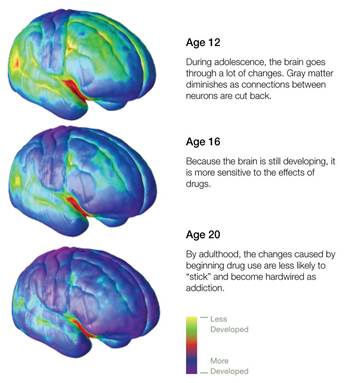
Too often, our messaging to youth is that “if I drank/smoked weed/used nicotine when I was young, you’ll be fine doing it, too,” but we want to give our children the best possible chance, so use National Alcohol and Drug Facts Week — or any day — to talk to your children about your expectation that they don’t use until they’re legally able to do so – or at least until they can talk about their use with you. I bet we’d see HUGE declines!
References
https://learn.genetics.utah.edu/content/addiction/adolescent
About Guida Brown & Guided by Guida
Guida Brown is the Principal for Guided by Guida and serves as the Community Relations Consultant for US Drug Testing Laboratories in Des Plaines, Illinois. She has served as an adjunct member of the faculty at Concordia University, UW-Parkside, Gateway Technical College, and Carthage College.
Having earned a bachelor’s degree in Journalism from Marquette University and a master’s degree in Management from Cardinal Stritch University, Brown made the nonprofit sector in Kenosha County her career. She was the Executive Director of the Hope Council on Alcohol & Other Drug Abuse, Inc., for over 13 years, resigning that position in June 2022. Prior to her tenure at the Hope Council, she worked as the Director of Human Resources and Training at AM Community Credit Union and Executive Director at Women and Children’s Horizons.
Brown is certified by the State of Wisconsin as a Substance Abuse Counselor, Fetal Alcohol Spectrum Disorder trainer, and Intoxicated Driver Program Assessor. She is an Associate Member of the College on Problems of Drug Dependence (CPDD) and a Junior Investigator with the Research Society on Alcohol (RSA).